
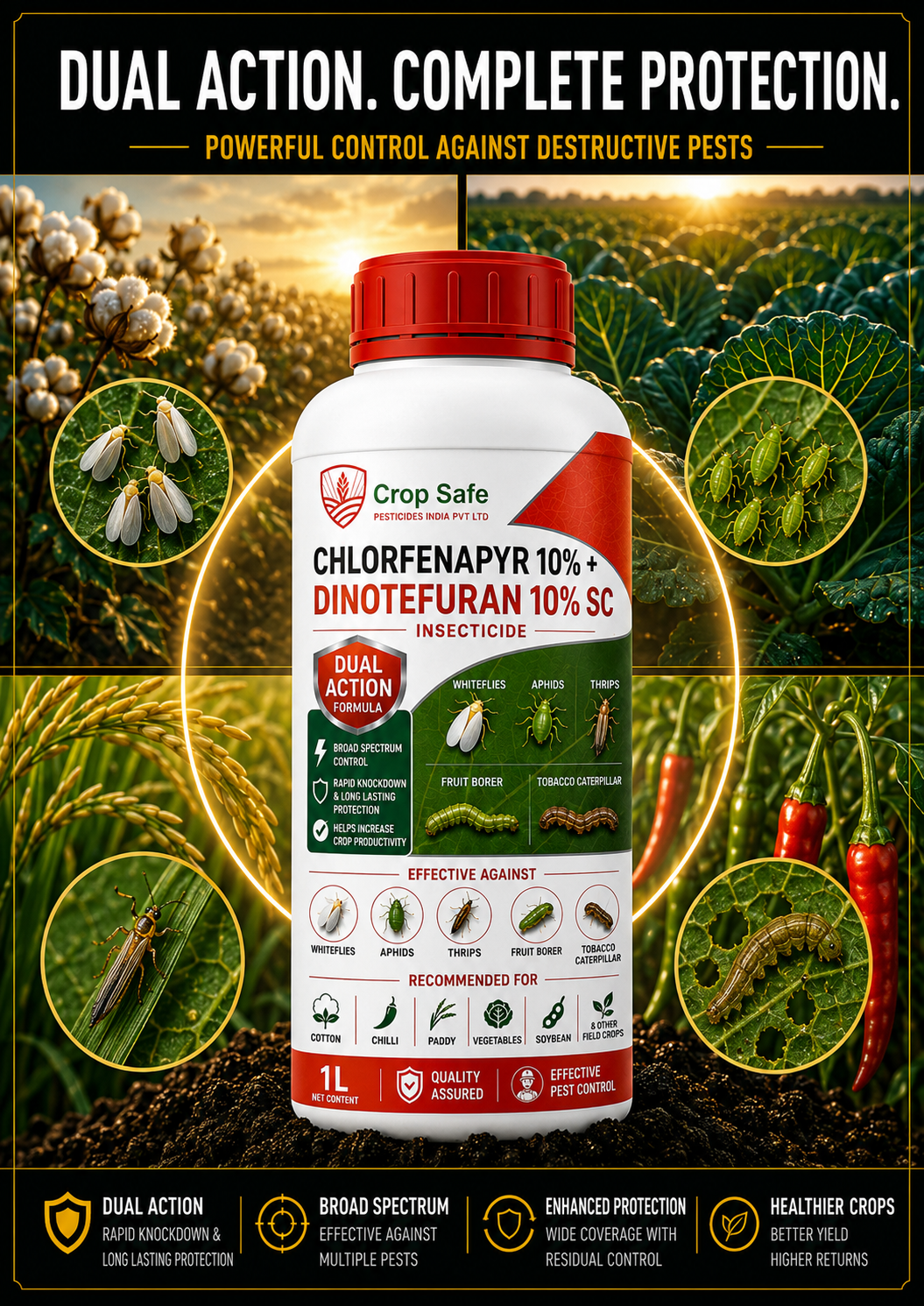
Insecticide
CHLORFENAPYR 10% + DINOTEFURAN 10% SC
Integrates contact, stomach, and systemic activity to provide broad-spectrum control of both chewing and sucking insect pests. The complementary chemistry delivers rapid pest suppression together with prolonged field protection.

Active: Chlorfenapyr + Dinotefuran
Formulation: SC (Suspension Concentrate)
Triple Action: Contact, Stomach & Systemic
Prolonged Protection
Product Information
Mode of Action
Chlorfenapyr (IRAC Group 13) disrupts cellular energy production by uncoupling oxidative phosphorylation, while Dinotefuran (IRAC Group 4A) interferes with nerve signal transmission through nicotinic acetylcholine receptors.
Target Pests
- Whiteflies
- Aphids
- Thrips
- Fruit Borer
- Tobacco Caterpillar
Recommended Application
| Recommended Crops | Targeted Pests | Dosage & Method of Application |
|---|---|---|
| Cotton | Whiteflies, Bollworms | Initiate treatment before pest populations reach damaging levels. |
| Chilli | Thrips | Apply during active pest development with thorough crop coverage. |
| Paddy | Sucking Pests | Spray according to crop growth stage and pest monitoring observations. |
| Soybean | Caterpillars | Integrate applications with recommended resistance management practices. |
| Vegetables | Fruit Borer | Continue field surveillance to determine subsequent treatments. |
For specific ml/ha dosage rates and local dilution instructions across crops, please refer to the registered product label or consult local agricultural experts.
Application Instructions
1. Timing & Field Surveillance
Initiate applications early during active pest development before populations reach damaging economic levels. Maintain regular field monitoring to evaluate pest pressure.
2. Crop Coverage & Resistance Management
Ensure thorough and complete spray coverage across the crop canopy. Integrate treatments within a rotation-based insect resistance management strategy.
Safety & Environmental Care
Always wear proper personal protective equipment (gloves, eye protection, overalls, mask) during mixing and application. Toxic to bees and aquatic organisms; avoid spraying during active pollinator activity and prevent chemical runoff into water bodies.