
Pyrethroid Insecticide
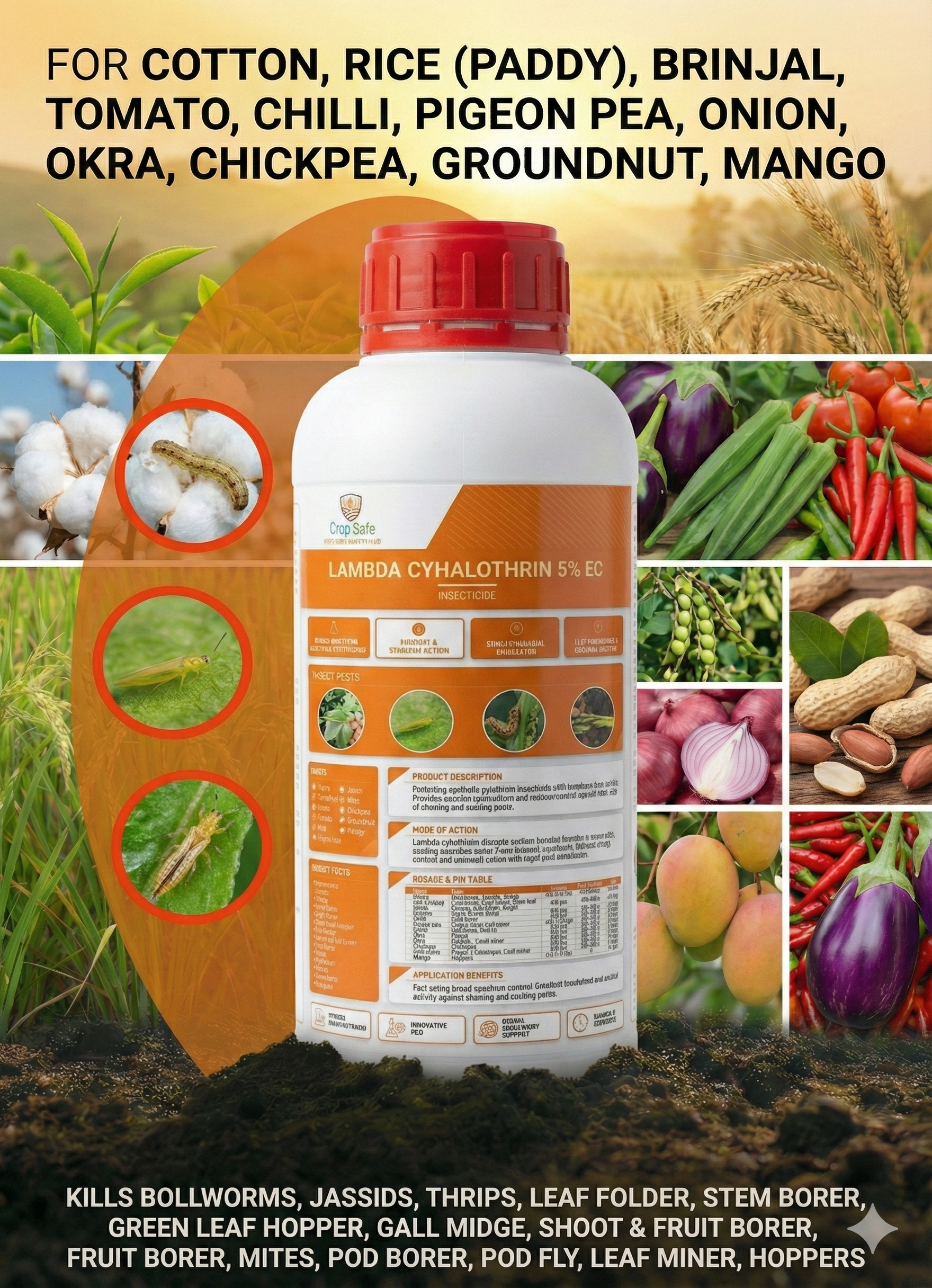
LAMBDA CYHALOTHRIN 5% EC
A fast-acting synthetic pyrethroid insecticide with broad-spectrum activity. It provides excellent knockdown and residual control against a wide range of chewing and sucking pests in various crops including Cotton, Rice, Vegetables, and Mango.
Active: Lambda Cyhalothrin
Formulation: EC (Emulsifiable Concentrate)
Action: Contact & Stomach
Product Information
Mode of Action
Lambda Cyhalothrin disrupts the sodium channel function in nerve cells. This causes repetitive nerve firing leading to hyperexcitation, paralysis, and death. It exhibits strong contact and stomach action, resulting in rapid pest knockdown.
Target Pests
- Bollworms, Fruit Borers, Shoot Borers
- Jassids, Thrips, Hoppers
- Leaf Folder, Stem Borer, Gall Midge
- Pod Borer, Pod Fly
- Mites, Leaf Miner
Key Benefits
Effective at low dosages with good residual activity. Works well against a wide spectrum of insect pests.
Recommended Dosage
| Crop | Target Pest | Dosage (ml/Ha) | Water (L/Ha) | PHI (Days) |
|---|---|---|---|---|
| Cotton | Bollworms, Jassids, Thrips | 300 – 500 | 400 – 600 | 21 |
| Rice (Paddy) | Leaf folder, Stem borer, GLH, Gall Midge, Thrips | 250 | 400 – 600 | 15 |
| Brinjal | Shoot & Fruit Borer | 300 | 400 – 600 | 04 |
| Tomato | Fruit Borer | 300 | 400 – 600 | 04 |
| Chilli | Thrips, Mite, Pod Borer | 300 | 400 – 600 | 05 |
| Pigeon Pea | Pod Borer, Pod Fly | 400 – 500 | 400 – 600 | 15 |
| Onion | Thrips | 300 | 300 – 400 | 05 |
| Okra | Jassids, Shoot Borer | 300 | 300 – 400 | 04 |
| Chickpea | Pod Borer | 500 | 300 – 400 | 06 |
| Groundnut | Thrips, Leaf Hopper, Leaf Miner | 300 | 400 – 600 | 05 |
| Mango | Hoppers | 0.5 – 1.0 ml/L | – | 07 |
Harvest Interval: Strict adherence to the Waiting Period (PHI) is required, especially for Cotton (21 days) and Rice (15 days), to ensure residue compliance.
Application Instructions
1. Timing
Apply when pest population reaches economic threshold levels (ETL). For borers, apply before larvae enter the plant tissue. For sucking pests, ensure coverage on the underside of leaves.
2. Resistance Management
This is a pyrethroid (Group 3A). Avoid repeated use of pyrethroids alone. Rotate with insecticides of different modes of action to delay resistance development.
Safety Precautions
Environmental Safety: Toxic to bees and aquatic life. Do not apply near water bodies or when bees are active.
Handling: Pyrethroids can cause temporary skin irritation (paresthesia). Wear gloves, face mask, and goggles during handling and spraying.
Handling: Pyrethroids can cause temporary skin irritation (paresthesia). Wear gloves, face mask, and goggles during handling and spraying.